
Have someone start the building evacuation and contact 911 before attempting to use a fire extinguisher.
WAC 296-800-30025 says that employees must be trained annually to use fire extinguishers. EH&S offers fire extinguisher training in the spring and the fall.
Topics on this page:
Fire

Three things are needed to produce fire:
- Oxygen (or another type of oxidizer)
- A fuel source
- Heat
If any of these elements is removed, the fire is extinguished.
Fire Classifications
Fires are classified according to the type of fuel that is burning. There are 5 fire classifications; A, B, C, D, and K. Each classification has a symbol and color that are usually associated with it.

Class A is ordinary solids, something like a trash can on fire would be a class A fire.
Class B is flammable liquids, frequently gasoline.
Class C is anything plugged into an outlet, or the outlet itself.
Class D are metals, these are usually found in science labs and are the least frequent. Class D fires require a special extinguisher to put out.
Class K are oils and fats, these are almost always kitchen fires.
Fire Extinguishers Types
There are a number of different types of fire extinguishers. Different extinguishers work on different fire classifications. Some extinguishers work on a single fire classification, and some work on multiple classifications. The extinguisher will always have information on its tag indicating which fire class(es) it works on. Usually the class pictograms are used to convey this information.
It is important to select the correct extinguisher for material that is on fire. Using the wrong extinguisher can sometimes make the fire worse.
Below are some of the different kinds of extinguishers and the fires they work on.
Dry Chemical (ABC)


The most common fire extinguishers are dry chemical. These are the extinguishers you will find around campus. They are red containers with a narrow flexible hose or a small nozzle.
Dry chemical extinguishers are filled with a fine yellow powder.
- They work by covering the fire, separating it from the oxygen it needs to keep burning.
- They work on Class A, B, and C fires, unless otherwise noted.
The powder is corrosive and can destroy electrical equipment.
Carbon Dioxide (CO2)

Carbon dioxide extinguishers are used on campus for training. They can also be found in some electrical rooms. They are typically red containers with a metal pipe and plastic horn.
Carbon dioxide extinguishers shoot carbon dioxide gas (and occasionally chunks of dry ice).
- The gas displaces the oxygen around the fire.
- The gas is very cold and helps to cool down the fuel.
- These extinguishers are good for Class B and C fires.
Smaller carbon dioxide extinguishers have a metal pipe that connects a plastic horn to the extinguisher base. Do not hold onto the metal pipe, it will get extremely cold and can cause frostbite. Hold the plastic horn when using these extinguishers.
Dry Powder (Class D)


Dry powder extinguishers are not common. On campus they are found in some labs and workshops. These extinguishers are found in two styles. They will either be yellow canisters with a very long, flexible hose or the material will be in a bucket with a scoop.
There are multiple kinds of dry powder extinguishers, each using different chemicals. The chemical selected must work for the kind of metal being used.
- These materials often melt and form a crust over the burning metal, excluding oxygen.
- Some contain other non-flammable metals that act as a heat sink.
The dry powder has to cover the entire surface of the burning metal and may need to be several inches thick to work properly.
Dry powder only works on class D fires!
Wet Chemical (Class K)

Wet chemical extinguishers are found in commercial kitchens. They tend to be large, silver extinguishers with a long, flexible hose.
They are usually made of water and a chemical that reacts with fats to form a soap.
- The chemical reacts with the burning oil to form a soapy foam layer, which oxygen cannot get through
- The water helps to cool the oil below its ignition temperature.
- These are rated for Class K or Classes A and K fires.
Fire Extinguisher Use
To use a fire extinguisher, remember the acronym P.A.S.S:
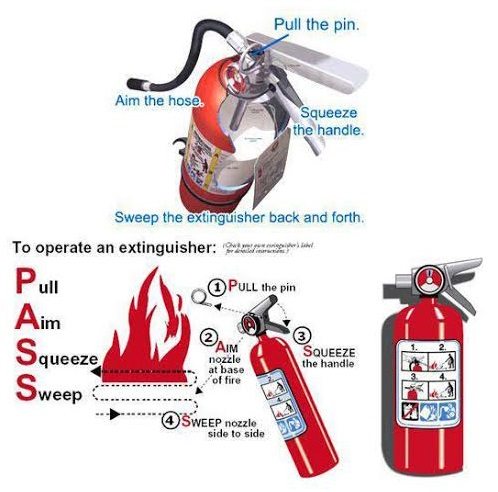
- Pull the pin
- Rest the lower handle on one hand and make sure you aren’t squeezing the handles together.
- If the pin is hard to pull out, twisting it in one direction will help break the plastic seal.
- Aim at the base of the fire
- Aim at the ground, or the surface that is burning, 2-3 feet in front of the fire.
- Squeeze the handles together
- Sweep the extinguisher from side to side, covering the entire burning area
- Walk forward as you sweep, don’t try to bend over and hold the extinguisher out in front of you.
If a fire is larger than a small garbage can, do not attempt to put it out. Fire extinguishers have limited extinguishing materials. The extinguisher will run out before you are able to completely put out the fire.
Make sure you have a clear exit pathway if you choose to use a fire extinguisher. You need to have a way out if you can’t control the fire.
Never attempt to fight a fire:
- If you do not know what is burning
- If you feel unsafe
- If the fire is large
Stay safe and leave the building instead! Remember, do not try to extinguish a fire until you know the building evacuation has begun and 911 has been notified.